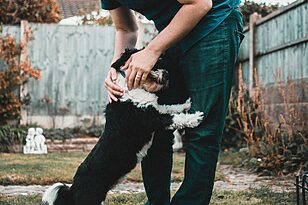
Jumping is one of the most common behavioral complaints dog owners bring to trainers, and it is also one of the most consistently mishandled. Not because owners lack effort, but because the instinct to correct a jumping dog by pushing them away, saying no firmly, or raising a knee reinforces the behavior rather than stopping it. Learning how to stop dogs from jumping begins with a shift in perspective: jumping is not defiance or disrespect. It is a social behavior dogs use to greet the people they are excited to see, and it gets reinforced every single time it earns any response at all. The goal is not to punish jumping. The goal is to teach your dog that keeping four feet on the floor is what earns the attention and connection they are looking for. That shift in approach is what makes it possible to stop dogs from jumping in a way that actually holds up across real life, not just controlled training sessions in your living room.
Understanding Why Dogs Jump Up
Dogs jump primarily to reach faces. In canine social behavior, greeting a familiar animal typically involves nose-to-nose or nose-to-mouth contact. When a dog tries to greet a human, who stands significantly taller, jumping is the natural solution to the height problem. Puppies use the same behavior to solicit attention from adults, reaching upward as an instinctive social gesture. The impulse to jump toward faces is deeply embedded in canine social wiring and is not something dogs grow out of naturally without intentional guidance from the people around them.
What makes jumping a persistent problem is how reliably it gets reinforced by the humans receiving it. A dog who jumps and gets pushed away has received physical contact. A dog who jumps and gets told no has received eye contact, vocal response, and focused attention. From the dog’s perspective, the behavior worked because it produced a response. The specific nature of that response matters far less than the fact that a response happened at all. This is precisely why the effort to stop dogs from jumping must target the reward structure rather than simply the behavior itself. Every time jumping earns any kind of response, the behavior strengthens. Every time jumping produces nothing, while calm greetings produce warmth and reward, the dog gradually learns which approach actually serves their social goals.
The Core Principle: Remove the Reward
The foundation of effective jumping training is a principle that sounds simple but requires genuine consistency to execute well. When your dog jumps, they receive absolutely nothing. No eye contact. No verbal acknowledgment. No physical touch of any kind, including the push away that feels like a correction but functions as contact. The moment your dog jumps, turn completely away and wait for four feet to return to the floor. That is the entire response, and it needs to be total to work.
This approach is called extinction, and it works by removing the reinforcement that has been maintaining the behavior. When a behavior that previously produced a reliable result suddenly produces nothing, most animals first increase the frequency and intensity of the behavior in an attempt to make the old strategy work again. This phase is called an extinction burst, and it is the moment when most owners abandon the method. They see the jumping escalate and interpret that as evidence the training is not working. An extinction burst is actually a clear sign the training is working exactly as expected. Staying committed through that escalation is the most critical skill in the effort to stop dogs from jumping permanently. If you consistently ignore jumping but occasionally respond once the dog reaches peak intensity, you inadvertently teach the dog that persistence pays off, making the behavior dramatically harder to eliminate.
Teaching Four on the Floor
Removing the reward for jumping addresses one half of the equation. The other half is actively reinforcing the behavior you want to replace it. Four feet on the floor needs to become reliably and immediately rewarding so your dog learns that calm greetings produce the attention jumping used to provide. Without a clear alternative to reinforce, you are suppressing a behavior without teaching anything new, and suppression alone rarely holds under real-world conditions.
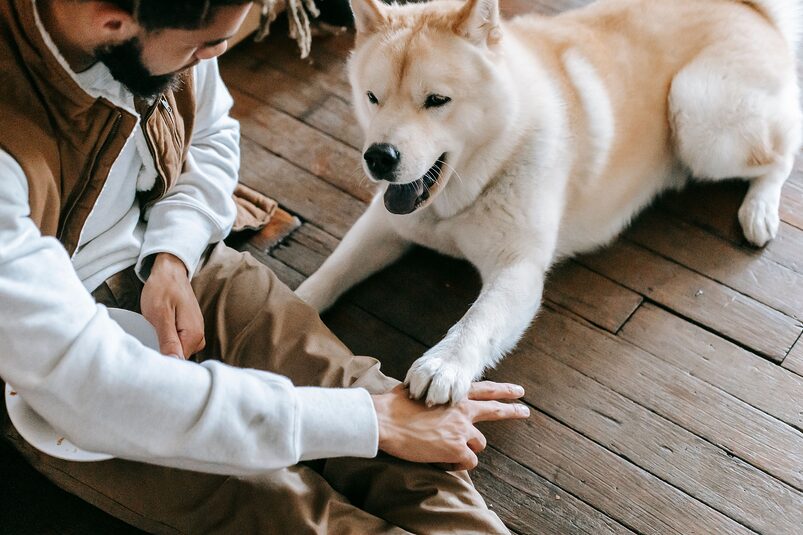
Start in low-distraction situations where your dog is only moderately excited. Approach your dog calmly. The moment all four feet remain on the floor, mark the behavior immediately with a word like yes or a clicker sound and deliver a treat or warm physical greeting. Keep your own energy calm during the reward. Matching your dog’s excitement escalates their arousal and makes jumping more likely in the next repetition. According to the ASPCA, consistently reinforcing an alternative behavior is the most reliable long-term strategy to stop dogs from jumping permanently. Repeat this sequence across multiple short sessions each day, and gradually increase the level of excitement in the greeting as your dog becomes consistent at lower arousal levels.
Practicing With the People Who Matter
A dog who has stopped jumping with you but launches into every visitor who walks through the door has learned a contextual rule rather than a general one. Dogs do not automatically apply a behavior learned with one person to every person they encounter. Generalizing the training to all people requires deliberately practicing with all people your dog regularly meets.
Brief your guests before they enter. Let them know that turning away completely the moment the dog jumps is the most helpful contribution they can make to the training. Guests who engage briefly with the jumping dog before turning away reset the reinforcement history and slow the entire process. Prepare frequent guests with treats so they can immediately reward four feet on the floor. The goal is for every single greeting your dog has with every person to produce the same consistent outcome: jumping earns nothing, calm feet earn warmth and reward. That message across all contexts is what transforms a selective habit into a reliable greeting behavior. Children deserve particular attention in this work, as they often squeal and move in ways that inadvertently reward jumping with exactly the kind of exciting response the dog is seeking.
Managing High-Arousal Situations
Some situations generate arousal levels high enough that a dog who handles normal greetings well cannot yet manage themselves. Returns from long absences, the arrival of a particularly exciting guest, or the energy of a familiar dog can temporarily overwhelm impulse control even in a dog whose training is genuinely well-established. Managing these situations proactively is far smarter than setting the dog up to fail and then attempting to address the jumping after it has already happened.
A leash at the door during high-excitement arrivals gives you a tool to redirect the dog before jumping begins rather than after. Asking the dog to go to a designated mat or place before a guest enters gives them a positive behavior to perform during the high-arousal moment. Practiced consistently, place training becomes the dog’s default greeting strategy, replacing the jump impulse with something they can actually execute successfully and be rewarded for. Even a minute of quiet waiting before opening the door reduces accumulated arousal and meaningfully changes how the greeting unfolds. That brief, practiced pause costs almost nothing and produces results that are consistently worth the habit.
When the Habit Is Deeply Established
Some dogs have been reinforced for jumping so consistently and for so long that the behavior has become deeply automatic. These cases require more time and more deliberate repetition than dogs early in the habit formation, but the same principles apply and the same results are achievable. The primary difference is the timeline rather than the approach.
The effort to stop dogs from jumping in deeply ingrained cases benefits significantly from management tools during the training period. A leash attached during greetings, a baby gate that controls access to the door, and a structured place routine all reduce the dog’s opportunity to practice the old behavior while the new one builds. Every time a dog practices jumping and receives a response, the behavior strengthens. Removing as many of those practice opportunities as possible during the training window accelerates the process meaningfully. Patience and humor also help. A dog who has been jumping enthusiastically for years has a strong behavioral history to work against, and celebrating the small wins of a four-footed greeting produces the forward momentum that eventually makes the change feel natural to everyone in the house.
The Greeting Your Dog Is Capable Of
The process to stop dogs from jumping teaches you as much about canine communication as it teaches your dog about greetings. The moment you stop responding to the jump and start rewarding the calm, you begin speaking in a language your dog genuinely understands. From there the training moves forward naturally, session by session and greeting by greeting. Every time a guest walks through your door to a dog who stands or sits quietly rather than launching into them, you see the investment paying off in a way that is genuinely satisfying for everyone in the room.
Keep the approach consistent, maintain the positive energy throughout, and give the process the time it deserves. The result is a dog whose greetings reflect the relationship you have built together rather than the habit that formed before you knew better. That kind of greeting, offered freely and calmly at every door, is one of the everyday joys of living with a well-trained dog and is absolutely worth the work it takes to get there.