A bored dog does not stay bored quietly. The energy that should go toward purposeful activity comes out through chewed furniture, relentless barking, and a determination to find stimulation wherever it exists in your home. Puzzle toys for dogs address this problem directly by giving dogs what they are naturally built for: a challenge to engage with, effort to apply, and a reward that feels genuinely earned. Mental exercise through puzzle toys for dogs is not a supplemental nicety. Veterinary behaviorists and animal scientists consistently classify mental stimulation as a core component of canine wellbeing, as essential to a dog’s health as daily physical activity. The market for puzzle toys for dogs has expanded significantly in recent years, moving well beyond basic treat-dispensing balls into multi-step feeders, lick mats, snuffle products, and graduated challenge systems designed for dogs at every skill level. Understanding what separates the best options from the ones that lose a dog’s attention in minutes makes the difference between a tool that genuinely changes your dog’s day and one that collects dust after a week.
Why Mental Stimulation Matters as Much as Exercise
Mental exercise taps into the same cognitive and sensory systems that working dogs use when performing jobs they were bred for. A herding dog spending the day in a suburban backyard carries the same brain that drove their ancestors to manage livestock for hours. A scent hound resting on the couch possesses the same powerful nose developed to track game across miles of terrain. Puzzle toys for dogs offer a domestic outlet for those same drives, redirecting that energy into structured activity that satisfies without requiring an outdoor job or a working role.
Research on canine enrichment consistently shows that mental fatigue and physical fatigue produce comparable behavioral effects. A dog who has spent twenty focused minutes working through a food puzzle is noticeably calmer and less demanding than a dog who has had physical exercise alone. According to the American Kennel Club, mental stimulation reduces boredom-related behaviors, supports cognitive health in aging dogs, and builds the kind of problem-solving confidence that transfers to training and everyday life. Adding puzzle toys to your routine does not replace physical exercise. It completes the picture.
Understanding Puzzle Difficulty Levels
The Nina Ottosson product line, widely regarded as the standard for structured canine enrichment, organizes their designs into four difficulty levels. Level one puzzles ask a dog to slide, push, or lift covers to find hidden treats. Level two adds multiple hiding spots and additional steps. Level three introduces more complex lock mechanisms that require sequential problem-solving. Level four presents the greatest challenge, requiring a dog to work through multi-step sequences before the reward becomes accessible.
Starting at the appropriate level matters more than most owners realize. A dog placed at level three without lower-level experience often becomes frustrated quickly, loses interest, and develops a negative association with puzzle work. Beginning one level below what seems easy builds confidence and teaches the dog that engaging with the puzzle leads to reward. Progress upward only when your dog consistently completes their current level without visible struggle or attempts to force the toy open.
Nina Ottosson Dog Tornado
The Nina Ottosson Dog Tornado is one of the most reliably effective entry-level puzzle toys for dogs available today. Its rotating discs feature compartments where treats are hidden beneath bone-shaped covers. The dog must spin the layers and remove the covers to reach the food. The toy is durable, dishwasher-safe, and available in multiple versions with varying difficulty settings that allow for progression as your dog’s skills develop.
The Tornado works particularly well for dogs new to puzzle work because the spinning layers provide immediate sensory feedback that holds a dog’s attention while they figure out the mechanics. Most dogs solve it quickly at the standard setting, which means the long-term value lies in increasing the challenge by using more stubborn covers and filling fewer compartments unpredictably. The variable hiding pattern alone extends the engagement value of this toy well beyond what a fixed-layout design could offer.
KONG Classic
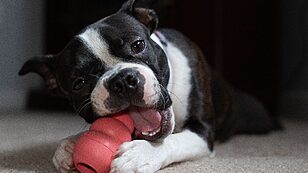
The KONG Classic is one of the most consistently recommended enrichment tools in veterinary and training communities, and its versatility earns that position. The hollow rubber design accepts a nearly unlimited range of fillings, from loosely packed kibble to elaborate layered combinations frozen overnight. A frozen stuffed KONG is among the best puzzle toys for dogs who eat too quickly, destroy plastic puzzle toys through brute force, or need sustained, quiet engagement during alone time or crating.
Its durability makes it appropriate for aggressive chewers who would dismantle a plastic puzzle in minutes. Its unpredictable roll on hard floors adds a mild physical challenge alongside the foraging element. Filling a KONG with a dog’s regular kibble mixed with a small amount of peanut butter or wet food and freezing it overnight creates an activity that can occupy a determined dog for fifteen minutes or more. For dogs with separation anxiety, a frozen KONG given at the moment of departure is one of the most effective behavioral management tools available.
LickiMat
The LickiMat takes a different approach to mental stimulation than traditional multi-step puzzle toys. Its textured rubber surface is spread with soft foods like plain peanut butter, unsweetened yogurt, mashed banana, or wet dog food, then licked clean over an extended period. The repetitive licking motion activates a calming neurological response that keeps dogs occupied far longer than the amount of food involved would suggest.
LickiMats perform particularly well in high-stress situations: veterinary visits, grooming sessions, thunderstorms, and departures that trigger anxious behavior. The sustained, rhythmic licking slows breathing and reduces arousal in a measurable way. They are inexpensive, easy to prepare and freeze in advance, and appropriate for dogs who cannot use harder plastic puzzles due to dental sensitivity. The LickiMat Splash and Slomo designs offer different texture patterns that vary the challenge in subtle but meaningful ways across daily use.
Paw5 Rock ‘N Bowl
The Paw5 Rock ‘N Bowl reimagines the standard food bowl as a slow-feeding enrichment tool. Its hemispherical base rocks and wobbles as the dog pushes it with their nose, dispensing kibble at a controlled rate that requires sustained engagement to empty. The design addresses two problems simultaneously: the boredom of a dog who finishes a meal in under sixty seconds and the health risks associated with eating too fast, including bloat and digestive discomfort in larger breeds.
For dogs who have already mastered stationary puzzles, the Rock ‘N Bowl’s movement adds a dimension of challenge that flat designs cannot replicate. The dog must continuously rebalance the bowl to keep food flowing rather than clearing one section and moving on. It performs best on low-pile carpet or a rubber mat, which prevents the bowl from sliding across smooth surfaces during use and keeps the rocking motion working as intended.
West Paw Toppl
The West Paw Toppl operates similarly to the KONG but with a wider opening that makes filling easier and cleaning more thorough. Its stackable design allows two Toppls to connect together, creating a more complex challenge as the dog figures out how to separate and access both chambers. West Paw’s material is certified toxin-free, dishwasher-safe, and durable enough for moderate to strong chewers without the same density that makes some rubber toys uncomfortable for dogs with sensitive teeth.
The Toppl works exceptionally well as a meal-replacement feeder for dogs who need to slow their eating or who require a high-value activity during crating or rest periods. Filling it with a dog’s regular kibble mixed with wet food and freezing it creates an activity that occupies a focused dog for fifteen to twenty minutes. The double-Toppl configuration is particularly useful for dogs who have mastered single-chamber designs and need a new layer of complexity to stay genuinely engaged.
Matching the Puzzle to Your Dog
Choosing the right puzzle toys for dogs is as important as the quality of the toy itself. High-drive dogs, particularly terriers, herding breeds, and sporting breeds, tend to benefit most from puzzles that engage their foraging and scenting instincts. Snuffle mats and level two to three Nina Ottosson puzzles work well for these dogs because they tap directly into the drives those breeds were developed to use.
Anxious dogs or those new to enrichment work often need the softer, more immediately rewarding experience of a LickiMat or a loosely stuffed KONG before they are ready for multi-step cognitive challenges. Starting too difficult with an anxious dog creates frustration rather than confidence. Senior dogs and those with physical limitations generally do best with stationary puzzles at level one or two, where treats are accessible without sustained physical manipulation that could cause discomfort or discouragement.
Getting the Most Out of Puzzle Time
Introducing puzzle toys for dogs as part of a consistent daily routine significantly increases their effectiveness as a behavioral tool. A dog who receives a puzzle at the same time each day, particularly during high-stress moments like owner departures or after high-arousal play, begins to associate puzzle time with calm, rewarding activity. That association builds over time into a genuine coping mechanism rather than just an occasional distraction.
Rotating your puzzle selection regularly prevents boredom with any single design. Most dogs have a short novelty window with any individual toy, but a rotation of three or four puzzles used across different days maintains engagement over months. Supervise early puzzle sessions to ensure your dog is problem-solving rather than attempting to force the toy open through destruction, which is a reliable signal that the difficulty level exceeds their current experience and needs to come down by one level.